
Blog
The 5 Best Plugins for WooCommerce Product Export to CSV

WooCommerce’s built-in product exporter produces a CSV, but the output format is fixed. You can choose which columns to include, but you cannot control how product images are separated, how product categories are structured in the export, how variation records relate to their parent products, or how individual field values are formatted.
Those limitations are fine for a basic catalog backup. However, they become a problem the moment a third-party platform hands you an export specification and expects your CSV file to match it.
The five plugins below are ranked by how much control they give you over those specific requirements.
Quick Comparison Table
| Plugin | Best For | CSV Output Control | Starting Price |
|---|---|---|---|
| WP All Export | Stores that need to match a third-party CSV specification | WP All Export exports product categories, images, attributes, and variation records as individually configurable columns, with a per-field Function Editor for value formatting | $169/yr (WooCommerce Export Package) |
| Woo Import Export | Stores needing import and export in one plugin | Includes a function editor for basic field adjustments. It has limited image options and no variation record type controls. | $229 (one-time, CodeCanyon) |
| Store Exporter | Stores needing basic CSV exports with no import requirement | Offers image export options. It has limited variation handling and no embedded function editor. | Free / $39.50/yr (Deluxe) |
| Product CSV Import Suite | Stores needing basic column-selection exports; note: being phased out by WooCommerce | Column selection only. It has no variation controls, image options, or function editor. | $59/yr |
| Product Import Export for WooCommerce | Stores needing a free starting point for basic product exports | Exports parent and variation records together with no selective control. It has no image formatting options or function editor. | Free / $69/yr (Pro, single site) |
I used a test store with a mix of simple and variable products, each with multiple images, product categories, and custom attribute values. I ran a product CSV export through all five plugins and looked for three things.
First, does the plugin give you any control over how product images are handled in the export — specifically, can you set a separator character between multiple image URLs, or is the output format fixed? Second, for variable products, can you choose whether to export variation records, parent product records, or both, or does the plugin always export everything together? Third, if the default output doesn’t match what you need, is there an embedded function editor that lets you reformat field values without touching theme files?
I didn’t test general import capabilities or non-product data types. This article is strictly about how precisely each plugin lets you control WooCommerce product CSV output.
5 Best Plugins for WooCommerce Product Export to CSV
- WP All Export
- Woo Import Export
- WooCommerce – Store Exporter
- WooCommerce Product CSV Import Suite
- Product Import Export for WooCommerce
1. WP All Export

⭐
Rating:
4.5/5 stars (based on 414 reviews on WordPress.org)
💰
Pricing:
From $169/yr (WooCommerce Export Package)
🎯
Best For:
Stores that need to match a third-party CSV specification; WP All Export controls image separator characters, product category columns, variation record selection, and individual field values without custom code
WP All Export exports WooCommerce products to CSV, Excel (XLS and XLSX), and XML from a single drag-and-drop interface. A basic product export (selecting columns, applying filters, downloading the file) takes a few clicks from the All Export › New Export screen. For exports that need to meet a third-party specification, WP All Export exports product categories, images, attributes, and variation records as individually configurable columns, with a per-field Function Editor that reformats any value before it reaches the file.
The plugin handles all standard WooCommerce product types, including simple, variable, grouped, external, and subscription products. It integrates natively with Advanced Custom Fields, Meta Box, JetEngine, Gravity Forms, WPML, and WooCommerce Brands, making custom field data available in the Available Data panel alongside standard product fields.
My Experience Using WP All Export
I ran a product export with a mix of simple and variable products, each with multiple images, product categories, and custom attribute values. The drag-and-drop column editor populated all standard WooCommerce fields automatically. Reordering and renaming columns took less than a minute.
For images, WP All Export exports featured images and attached images as separate selectable fields. The image separator character defaults to a pipe but is editable directly in the column configuration. I changed it, added a PHP function to wrap each image URL in quotes, and ran the export. The output matched the format exactly.

For variable products, WP All Export exports variation records, parent product records, or both from the same export template. I tested all three configurations. The variation title field accepts a custom value per variation, which I set using the Function Editor. Product categories exported as their own named column, structured cleanly for the downstream platform I was testing against.

What I Liked
- WP All Export exports product categories as individually configurable columns; the column name, separator, and format are all adjustable without writing custom code.
- The Function Editor is embedded directly in the column configuration screen. Reformatting a field value such as wrapping image URLs, normalizing attribute labels, or stripping HTML from descriptions, takes one function and a preview check, not a round-trip through functions.php.
- WP All Export exports product variations, parent products, or both from the same template, with separate title controls for each record type.
- Export scheduling runs through the Automatic Scheduling service ($19/mo), which triggers exports from within WP All Export’s interface rather than requiring manual cron configuration. The same license covers both WP All Import and WP All Export.
- WP All Export generates Google Merchant Center product feeds using a dedicated template, without a separate feed plugin.
- The Zapier integration connects exports to over 1,000 external applications in real time, including Google Sheets, without downloading or re-uploading files.
What I Didn’t Like
- The WooCommerce Export Add-On is required for product exports and is not included in the base WP All Export Pro plan; it comes bundled in the WooCommerce Export Package at $169/yr.
- The Function Editor requires basic PHP knowledge. Stores without a developer on hand may need to rely on documentation for anything beyond simple string formatting.
Pricing
WP All Export’s WooCommerce Export Package starts at $169/yr and includes Export Pro plus the WooCommerce Export Add-On. A lifetime license is available at $1,299 (one-time payment) and covers all current and future add-ons with no renewal fees. The Automatic Scheduling service is a separate optional add-on at $19/mo, covering unlimited sites.
Recommended For
WP All Export is the right choice when the product CSV output needs to meet a specific format, whether that’s a supplier feed, a Google Merchant Center submission, or a migration target with fixed column requirements. It handles a basic export just as directly as a complex one; the Function Editor and variation controls are there when the job needs them, and out of the way when it doesn’t.
For more information, see Easily Export WooCommerce Products to XML & CSV.
2. Woo Import Export
⭐
Rating:
3.94/5 stars (based on 194 reviews on CodeCanyon)
💰
Pricing:
$229 (one-time, via CodeCanyon)
🎯
Best For:
Stores needing import and export in one plugin. It includes a function editor for field-level output adjustments.
Woo Import Export is a CodeCanyon plugin for importing and exporting WooCommerce products, orders, categories, coupons, and users. It supports multiple file formats and has a drag-and-drop field mapping screen, along with a function editor for modifying field values during export.
One practical consideration before purchasing: the plugin was last updated in March 2025 and its compatibility is listed up to WordPress 6.7. Stores on current WordPress versions should verify compatibility before buying.
My Experience Using Woo Import Export
Setting up a product export required more manual configuration than I expected. There is no automatic column population on a new export. Fields need to be added individually or loaded from a previously saved template.
A function editor is available for field transformations. Getting to it involves navigating a separate section of the interface rather than accessing it at the column level. Documentation for functions beyond basic string manipulation is also quite limited.
Variable product exports support parent records, child variations, or both as separate options. Image export is available, though there are no dedicated controls for setting a separator character between multiple image URLs or adjusting the output column structure.
What I Liked
- The pricing is a one-time payment. There is no annual renewal requirement.
- A function editor is included. It handles basic transformations such as concatenating values or stripping characters.
- Multiple file formats are available for both import and export. These include CSV, XLS, XLSX, XML, JSON, and ODS.
- Scheduled exports are included. Background processing is supported.
What I Didn’t Like
- The update cadence has slowed significantly. The last release was March 2025, with no updates since, and WordPress compatibility is only confirmed up to version 6.7.
- Image export has no dedicated formatting controls. There is no way to set a separator character between multiple image URLs or adjust the image column structure to match a third-party specification.
- The function editor is not embedded at the column level. Accessing it requires navigating a separate section of the interface.
- Support comes through CodeCanyon. Each purchase includes six months of coverage, with an option to extend to twelve months at additional cost.
Pricing
Woo Import Export is a one-time purchase at $229 on CodeCanyon. No free version or trial is available before purchase. Support is included for six months, with a twelve-month extension available at an added cost.
Recommended For
Woo Import Export is an option for stores that need import and export functionality in a single plugin and prefer a one-time payment structure. Stores that need precise control over image column formatting, variation output structure, or a function editor embedded directly at the column level will find those capabilities in the first plugin on this list.
For more information, see Woo Import Export on CodeCanyon
3. WooCommerce – Store Exporter
⭐
Rating:
4.1/5 stars (based on 165 reviews on WordPress.org)
💰
Pricing:
Free / $39.50/yr (Store Exporter Deluxe)
🎯
Best For:
Stores needing basic CSV exports with no import requirement. It offers image export options but has limited variation handling.
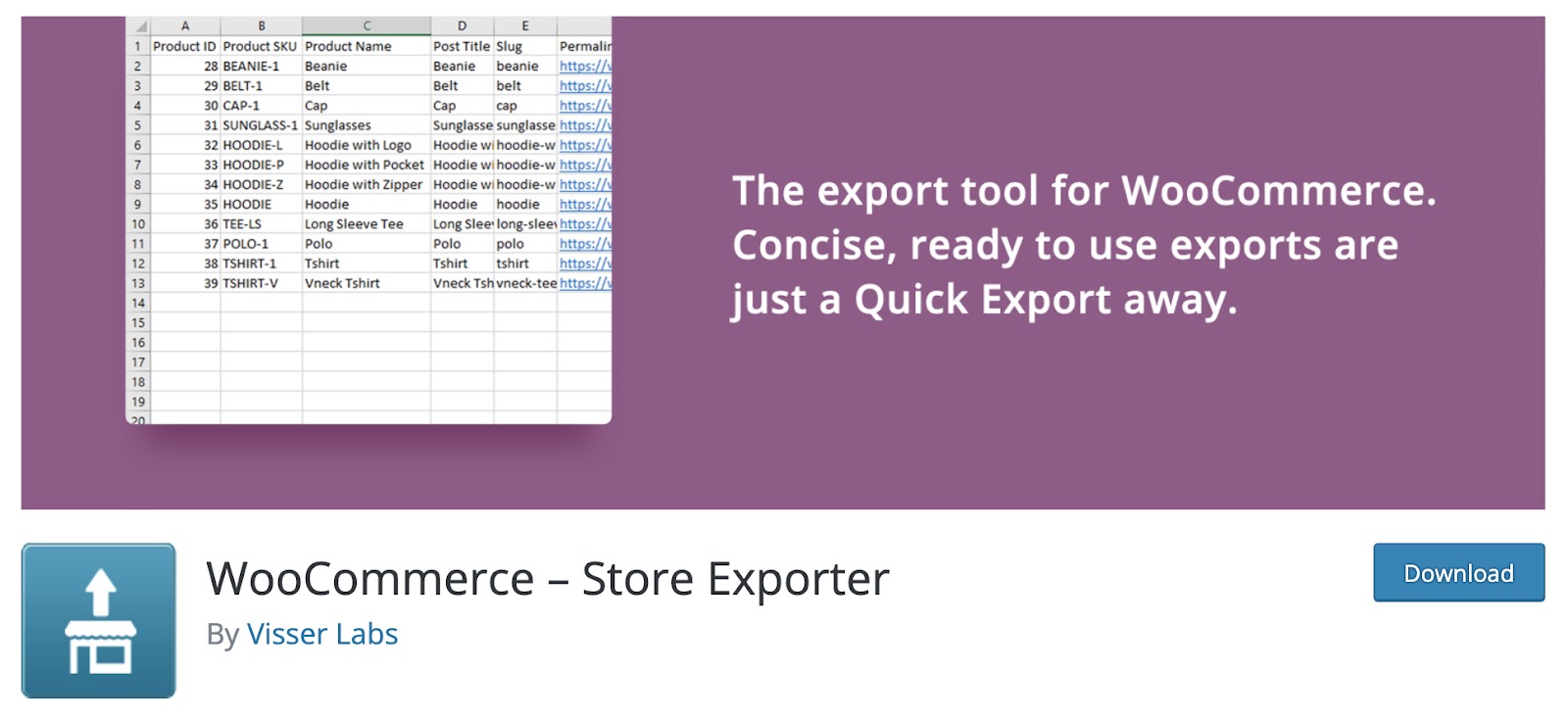
Store Exporter is a WordPress.org plugin for exporting WooCommerce data like products, orders, customers, categories, tags, and subscriptions. It is export-only with no import capability in either the free or premium version.
The free version exports to CSV. Additional file formats like XLS, XLSX, XML, TSV, and RSS require the Deluxe upgrade, as do scheduled exports, export templates, WPML compatibility, and FTP/SFTP delivery.
My Experience Using Store Exporter
The free version gets to a CSV file quickly. Field selection is checkbox-based, and the Quick Export button fires the export without additional configuration screens. For a basic product list that includes data like names, SKUs, prices and stock, it does the job without much setup.
The limits show up when the output needs to match a specific format. There is no embedded function editor. Adjusting how a field value is formatted in the export file means adding a custom hook or filter to functions.php which is not something every store owner will be comfortable doing.
Variation handling exists but is restricted. The plugin can include variations in a product export, but the options for controlling which records appear and how they relate to parent products are limited. Image fields are exportable, though there are no dedicated controls for separator characters or column structure.

The v2.8.1 changelog is worth noting. The previous release (v2.8.0) introduced a new admin interface and shipped with a significant number of bugs; export filters being silently ignored across multiple export types, a CSV injection vulnerability, and a security issue in the download endpoint. These were, however, addressed in v2.8.1.
What I Liked
- The free version is available on WordPress.org. It exports WooCommerce products to CSV without requiring a paid license.
- The Quick Export button produces a file without navigating multiple configuration screens. It is available from the WooCommerce Products admin screen directly.
- The Deluxe upgrade is priced at $39.50/yr. It is the lowest annual price of any plugin on this list.
- Integration is listed for 125+ WooCommerce extensions in the Deluxe version. It covers data from plugins like WooCommerce Bookings, WooCommerce Subscriptions, and Sequential Order Numbers.
What I Didn’t Like
- There is no function editor. Customising the format of any field value in the export output requires writing a custom hook or filter in functions.php.
- The free version is limited to CSV output. Every other file format requires a paid upgrade.
- Variation output control is limited. There are no dedicated options for selecting whether to export parent products, variations, or both as separate record types, or for adjusting the title used for variation rows.
- Image export has no formatting controls. There is no way to set a separator character between multiple image URLs or adjust the column structure to meet a third-party specification.
- Support has been a recurring point of criticism in recent reviews, with multiple users reporting slow or absent responses from the support team.
Pricing
The free version is available on WordPress.org. The Deluxe upgrade costs $39.50/yr and adds additional file formats, scheduled exports, export templates, WPML support, and FTP/SFTP delivery.
Recommended For
Store Exporter suits stores that need a free option for basic CSV exports and have no requirement to customise field output or control variation record structure. Stores that need on-the-fly field formatting, precise variation and image column control, or the ability to meet a third-party export specification will need a different tool.
For more information, see Store Exporter on WordPress.org.
4. WooCommerce Product CSV Import Suite

⭐
Rating:
2.8/5 stars (based on 12 reviews on WooCommerce.com)
💰
Pricing:
$59/yr (via WooCommerce.com)
🎯
Best For:
Stores already using WooCommerce’s extension ecosystem that need to go beyond the built-in importer. Note: WooCommerce has stated this extension will eventually be phased out.
WooCommerce Product CSV Import Suite is a premium extension sold through WooCommerce.com. It handles importing and exporting WooCommerce products via CSV. The extension goes beyond WooCommerce’s built-in importer by adding support for custom fields, custom taxonomies, and data from specific extensions including Product Vendors, WooCommerce Brands, WooCommerce Photography, and Google Product Feed.
One fact worth knowing before purchasing is that WooCommerce has stated in its own documentation that this extension will eventually be phased out, with its features folded into WooCommerce directly. No timeline has been given, but it is relevant for stores evaluating a long-term investment in an import/export tool.
My Experience Using WooCommerce Product CSV Import Suite
Setup requires preparing CSV files in WooCommerce’s expected column structure. There is no drag-and-drop field mapping — column names in the file need to match what the extension expects. Getting this right on the first attempt takes some familiarity with the required format.
Variable products are handled through two separate files: one for parent products and one for variations. Each file is imported in sequence. The process is workable, though it adds steps compared to handling parent and variation records in a single import run.

Export is limited to column selection. There are no controls for how field values are formatted in the output, no image separator options, and no way to choose whether to export parent records, variation records, or both independently.
There is no scheduling. Every import and export runs manually.
What I Liked
- Custom field and custom taxonomy data is supported without requiring custom code. It can be included in imports and exports alongside standard product fields.
- Extension compatibility covers specific use cases not handled by the built-in WooCommerce importer. These include Product Vendors, WooCommerce Brands, and Google Product Feed data.
- Export is available for products in published, private, and draft status. An offset and row limit are available to break large catalogs into smaller export batches.
- The extension is sold by WooCommerce directly. It carries a 30-day money-back guarantee and is maintained with updates and support.
What I Didn’t Like
- There is no field mapping interface. Column names in the import file must match the extension’s required format exactly, with no drag-and-drop or dropdown mapping to resolve mismatches.
- Variable products require two separate CSV files. Parent products and their variations cannot be handled in a single import run.
- Export output is not configurable. There are no controls for image field formatting, variation record selection, or field-level value adjustments.
- There is no scheduling. Imports and exports do not run automatically.
- The extension has no on-the-fly data manipulation. Values in the import file cannot be modified during the import process.
- The extension will eventually be discontinued. WooCommerce has stated it will be phased out and its features absorbed into core WooCommerce, which introduces uncertainty about long-term support and development.
- The rating on WooCommerce.com is 2.8 out of 5 across 12 reviews. Several reviews cite issues with variable product imports not functioning as expected.
Pricing
WooCommerce Product CSV Import Suite is available through WooCommerce.com at $59/yr for a one-year plan, or $94.40 for a two-year plan. The subscription includes product updates, customer support, and a 30-day money-back guarantee. It is only available through WooCommerce.com and there is no free version.
Recommended For
WooCommerce Product CSV Import Suite is an option for stores that need to import custom field data or data from supported extensions such as Product Vendors and WooCommerce Brands, and whose catalogs fit the extension’s fixed CSV structure without requiring field mapping or output formatting. Stores that need scheduling, on-the-fly data manipulation, image field controls, or a single-file workflow for variable products will find those capabilities in the first plugin on this list.
For more information, see Product CSV Import Suite on WooCommerce.com.
5. Product Import Export for WooCommerce
⭐
Rating:
4.6/5 stars (based on 411 reviews on WordPress.org)
💰
Pricing:
$69/yr (single site)
🎯
Best For:
Stores needing standard filtered exports across basic product types. It exports parent and variation records together with no selective control.
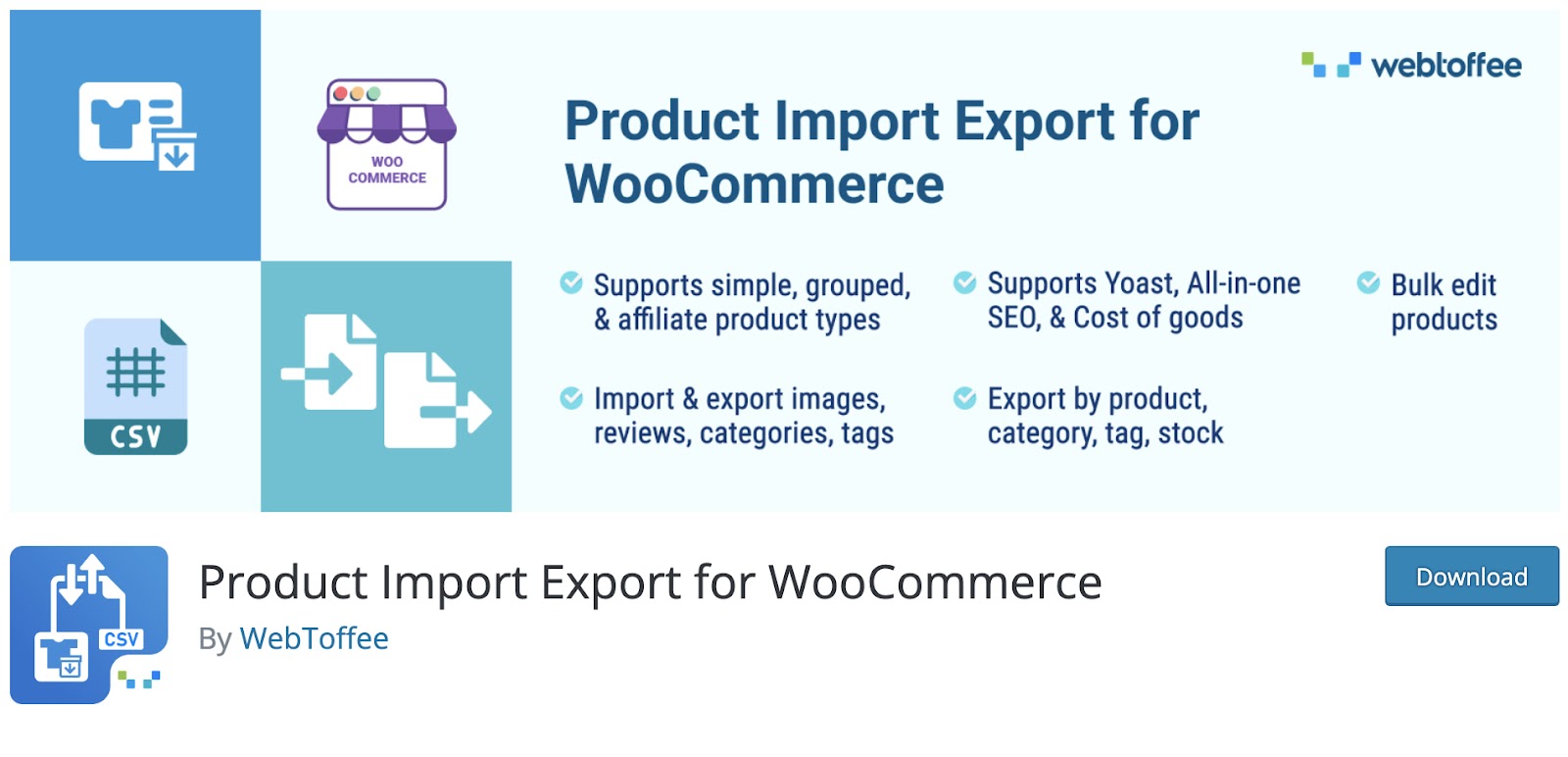
Product Import Export for WooCommerce is a plugin by WebToffee for importing and exporting WooCommerce products via CSV. A free version is available on WordPress.org. It handles simple, grouped, and external/affiliate products. Variable product support is not included in the free version; it requires the Pro upgrade.
The Pro version adds variable products, XML and Excel file formats, scheduled imports and exports, FTP/SFTP file delivery, custom fields, and compatibility with various third-party plugins. WPML support is included in the Pro version for simple products but does not extend to variable or subscription products.
My Experience Using Product Import Export for WooCommerce
The free version covers straightforward product exports without much configuration. Column selection is available, and export filters let you narrow the export by category, tag, stock status, and product type before running.
Column mapping on import uses a dropdown interface. Each column in the import file is matched to a WooCommerce field via a dropdown menu rather than a drag-and-drop mapping screen. The mapping is saved as a reusable template.
The plugin includes evaluation rules for modifying field values during import. These cover basic conditional logic. There is no inline PHP function editor so values requiring more complex transformation need to be prepared in the source file before import.
For variable products in the Pro version, parent and variation records export together in a single file. The plugin does not offer the option to export only parent records, only variation records, or to set a custom title for variation rows in the output.
Image export is available. There are no dedicated controls for the separator character between multiple image URLs or for the column structure of the image field in the export output.
What I Liked
- A free version is available on WordPress.org. It handles simple, grouped, and external/affiliate product imports and exports without a paid license.
- The plugin has 80,000+ active installs. It is actively maintained, with a compatibility update released in September 2026.
- Export filters are available in the free version. Products can be filtered by category, tag, stock status, product type, and status before export.
- Reusable import and export templates are supported. Previously used configurations can be saved and applied to future runs.
- An import history log is kept. Past imports are stored and can be re-run when needed.
What I Didn’t Like
- Variable product support is behind the Pro paywall. The free version is limited to simple, grouped, and external/affiliate products.
- There is no inline PHP function editor. Data transformations during import are limited to the plugin’s built-in evaluation rules.
- Column mapping uses dropdowns rather than drag-and-drop. Each field is matched via a menu selection.
- Export output for variable products is not configurable. Parent and variation records export together with no option to separate them or control which record types appear.
- Image export has no formatting controls. There is no separator character option and no way to adjust the image column structure to meet a third-party format requirement.
- WPML support in the Pro version covers simple products only. Variable and subscription product types are not supported by the WPML compatibility layer.
Pricing
The free version is available on WordPress.org. The Pro version starts at $69/yr for a single site, $129/yr for up to five sites, and $249/yr for up to 25 sites. All plans include one year of updates and support, and a 30-day money-back guarantee.
Recommended For
Product Import Export for WooCommerce is an option for stores that need a free starting point for basic CSV exports of simple and grouped products, or a mid-range paid option for variable product exports where output format control and inline data transformation are not requirements. Stores that need to control image field formatting, variation record selection, or field-level transformations during the export itself will find those capabilities in the first plugin on this list.
For more information, see Product Import Export for WooCommerce on WordPress.org.
WooCommerce Product Export to CSV — Wrap-Up
The free options on this list; Store Exporter and the free tier of Product Import Export for WooCommerce, cover basic column-selection exports without a paid license. However, they have no image formatting controls, no variation record selection, and no way to adjust field values before they hit the file.
WP All Export exports product categories, images, attributes, and variation records as individually configurable columns in a CSV file. Its per-field Function Editor reformats any value before it reaches the file without requiring code in functions.php. For stores that need to meet a third-party CSV specification, WP All Export handles it from within the export interface itself.
For a broader look at WooCommerce product export options, see The 5 Best WooCommerce Product Export Plugins.
Common Questions About Exporting WooCommerce Products to CSV
Can I export WooCommerce product categories to a CSV file?
To export WooCommerce product categories to a CSV file, you need a plugin; WooCommerce’s built-in export tool handles products but not categories as a standalone export. WP All Export exports product categories by selecting Taxonomies as the export post type and Product Categories as the subtype. The export layout includes category name, slug, description, parent ID, and parent name fields, which preserves hierarchical category structures in the output file.
Can I export WooCommerce variable products to CSV?
Yes. Variable products can be exported to CSV, though the level of control over the output depends on which plugin you use. WP All Export exports variable products, parent products, or both from the same export template, with separate controls for variation record types and titles. WooCommerce’s built-in exporter exports variable products but offers no control over whether parent records, variation records, or both appear in the file, and no formatting options for the output.
Can I schedule WooCommerce product exports to run automatically?
Yes. WP All Export schedules product exports to run automatically through its Automatic Scheduling service, which sets exports to run weekly or monthly directly from within the plugin’s interface without manual cron configuration. The scheduling service confirms each run completes as expected. Manual cron job setup is also available for stores that prefer server-side scheduling.
How do I export WooCommerce products with images to CSV?
To export WooCommerce products with images to CSV using WP All Export:
- Go to All Export › New Export and select WooCommerce Products as the post type.
- Click Customize Export File to open the Drag & Drop screen.
- Add the Featured Image and Gallery Images fields from the Available Data panel to your column selection area.
- Click the image column to open its configuration and set the separator character between multiple image URLs — the default is a pipe character.
- If the receiving platform requires a specific image format, open the Function Editor within the column configuration and apply a PHP function to reformat the values before they reach the file.
- Click Continue, configure any remaining export settings, and run the export.
Further Reading
Get Oxygen
Build it your way with Oxygen.
$199.50
once — unlimited sites, no renewal
Not per year, not per site, not per seat. 60 day money back guarantee.